Posts

The Internship Experience and Closing Thoughts

Greetings, this will be the last post of my internship.  If you have been a persistent reader please accept my personal thanks! In reality, I know that Dr. French and Dr. Gannon are the main absorbers of my written content.  While the process of assisting in guided research and critical writing is integral to the internship experience, one point of contention continues to remain even after this post. That is the conflict of history and memory. Perhaps the most enduring aspect of history is that it is interpreted  and that memory is owned  by the individual. Without gaslighting our veterans I encourage some reflection on the memory of recent wars/conflicts and how historians analyze and discuss past events. Recently, I talked to a man named Jerry at my place of work. Jerry is a veteran of the Vietnam conflict, one the United State joined nearly a decade after its inception. After enlisting "to fight the spread of communism," Jerry was shipped off to fight his way up t...

From Necessity and For Honor

Image
Greetings, this week I will be reviewing the National Park Service (US Dept. of Interior) essay  From Necessity to Honor: The Evolution of National Cemeteries in the United States by Kelly Merrifield.   Bodies gathered for burial after the Battle of Antietam. Collection of the New York Historical Society Just like Memorial Day, National Cemeteries were initially created to honor the Union soldiers killed during the Civil War. These cemeteries would eventually become gravesites and memorials for all United States veterans. The first few National Cemeteries - including Alexandra and Antietam - were established in 1862 around a year after Confederate forces first started firing on Fort Sumter. But by the 1870s, "almost 300,000 Union soldiers and sailors were buried" across seventy-three national cemeteries. Today, we have more than 175 cemeteries or lots designated for our war dead or past veterans and are managed by the National Cemetery Administration of the Department of ...

Concluding the 1994 Survey of Olustee

Image
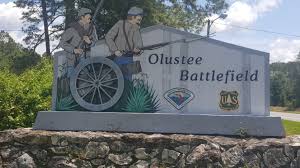
Greetings, this week we analyze more of Daniel T. Penton's original comments about the Olustee battlefield in 1994 and add new first-hand accounts to the Olustee narrative. Pictured: the site of the battle at Olustee. Photo courtesy of the Author, 2021. The full reconnaissance level survey was a cumulative endeavor by Penton and the  Olustee Battlefield Citizens Support Organization (CSO). Many historical documents from private collections, artifacts, funding, and relevant secondary sources stemmed from the members of the CSO. In fact, the CSO prides itself as the "watchdog" organization of Olustee; to both protect and improve for future generations. As such, both Penton and Leigh sought to include whatever they could from the CSO when undertaking their massive field survey. One aspect of the project saw the archaeologists canvassing more than the "site" of the final battle (where the Park is today). Instead, they also included substantial subsurface testing of ...

Surveying the Archaeology of Olustee

Image
Greetings, this week we are examining the history of the landscape prior to the battle and the 1994 archaeological survey of the Olustee Battlefield as it relates to the missing Union dead.  The origin of the survey is credited to the Olustee Battlefield Citizens Support Organization (CSO), with financing provided by the Bureau of Historica Preservation, Division of Historical Resources, Florida Department of State, along with early CSO support (Penton and Leigh III, 4). Daniel T. Penton, the Principal Investigator, stressed in the report that the survey was primarily focused on properly denominating the battlefield and assisting in the long-range interpretation of the site (Ibid). Initially, the report summarizes the location and physical setting of the battlefield. The principal survey area was south of Ocean Pond and east of the actual Town of Olustee (Ibid, 6). The geological range varies between "Central Highlands" elevations greater than 100 feet, mean sea level (msl), ...

The USCT of Olustee and the Aftermath of the Battle

Greetings, today we explore some witness testimonies at the Battle of Olustee and its aftermath. As was described in previous posts, the combatants that met at Olustee consisted of roughly the same number of Confederate and Union men. Just over 5,000 soldiers made up the Union forces and consisted of segregated regiments. The Confederates had roughly the same without segregated units. The US Colored Troops (USCT), a now historical term that is indicative of the social dilemmas plaguing freedmen and black veterans at the time, were largely represented by the 54th Massacheussats, 35th USCT, and the 8th USCT at Olustee.  Unlike its more famous partner, the 54th Mass., the 35th USCT had not seen combat before battling at Olustee. Most of the unit's men were ex-slaves from Virginia and the Carolinas while its officers came primarily from the North (35th USCT letter from Col. Beecher).  "I have the honor to acknowledge receipt of communications 9th inst directing me to assume comman...

The Olustee Museum

Image
 Greetings, this week we are reviewing the trip to Olustee and the maintenance of the Lost Cause narrative in Florida. Prominently positioned in the viewing room, this First National/Stars and Bars flag signifies the reign of the Confederacy and was first employed by the CSA on March 4, 1861. Olustee's small museum features the memory of the Confederate forces as the main attraction. Hanging on its wooden, paneled walls are numerous educational boards that tout Confederate successes amid Union (northern) aggression.  Florida was seen as culturally similar and economically tied to the other southern states. As a result, Florida withdrew from the Union January 10, 1861 and was determined to defend the right to enslave people while resisting Federal intervention efforts. Initially, Florida was an independent state which formed its own militia to overcome Union fortifications. However, money soon drained from the state's coffers and Florida could only maintain its troops with assi...

Compromising with the South: Black Labor during Reconstruction

Image
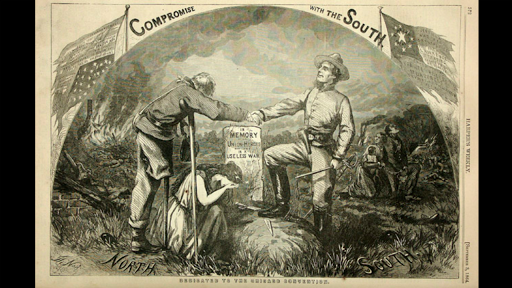
Greetings, this week we will continue exploring race relations and black labor during Florida's reconstruction period, the use of convict labor in southern states, and segregation.  The attitudes of Southerners would be a determining factor in a successful relationship between white men and freedmen (Day 2004, 3). Ultimately, the end of slavery caused numerous problems both for former confederates, as well as freedmen and abolitionists. Initially, the maintenance of status was of key importance to race relations in Florida: the dominant class did not want to relinquish control over resources, of which one was slavery (Ibid, 8).  In Florida, white businesses and landowners sought to maintain the pre-War status quo and were the dominant enactors of legislation. Dr. Christopher Day describes this as the "Holy Trinity" of race relations: political control, labor [and] property control, and violence (Ibid, 9).  The legalization of race relations may have been a result of fear-...

The Black Dilemma in Post-War Florida

The goal of the Republican party after the Civil War was to ensure political stability and maintain Reconstruction laws in Southern states.  Florida was one of several formerly Confederate states to be occupied by Union forces well after the end of the Civil War. Southern White attitudes about Black Freedman were not positive. Wealthy and influential Democrats often sought to prevent Freedman from owning land or establishing themselves permanently.  Northern policy initially encouraged Unionism among the southern population. At the time, Republicans believed that reintegrating rebellious states into the Union would be easy. Union loyalists were installed in Florida to support sectional reintegration. Military rule was supposed to end July 4, 1868 but then-Governor Harrison Reed requested Union troops to stay fearing intense White resentment. The presidential election of 1876 marked the end of Reconstruction. Florida, Louisiana and South Carolina disputed the election between D...

Reconstruction Florida: Quick Links and References

Image
Please note: this is a live page and subject to change

Emancipation Betrayed: Reconstruction amid Southern Resistance

Image
Greetings, this week we examine the Federal government's role in Reconstruction, how embittered Southerners resisted, and the implications of "ending" Reconstruction.   By April of 1865, many remaining Confederate forces under the direction of General. Robert E. Lee surrendered at the Appomattox Courthouse in Virginia; although occasional cells of white rebels would continue to resist Union occupation, the Confederacy had essentially exhausted its wartime capabilities. General Lee's surrender staunched the hemorrhaging of raw materials and men from the South. Nonetheless, those disgruntled Confederate veterans survived and returned home. Frequently these officers and veterans became statesmen, lawyers, plantation owners, and farmers after returning home.  Before the Civil War, Florida was on a trajectory to have booming cotton, lumber, and meat markets; all supported with the use of slaves as laborers. Union efforts to recruit Africans and sympathetic Whites were only...

All Wars are Extensions of Politics

Image
Greetings, this week we examine Florida's role in the Confederacy, its limited battlefield memory, and Olustee during Reconstruction. Florida's support of the Confederacy is often an overlooked aspect of the Civil War. As part of the original secessionist troupe, Florida joined Alabama, Georgia, Louisiana, Mississippi, South Carolina, and Texas as part of the first wave of secession from the Union. While the State legislature and a majority of the White Male population of Florida supported secession, some 2,000 people (both White and African) fled to join the Union. Aside from four regular contingents of men and two cavalries, Florida mostly supplied the Confederacy with salt, beef, and timber throughout the war. Salt was the best way to preserve the meat harvested from the vast cattle farms in the state. Enslaved Africans and other workers extracted this precious mineral from Florida's coastal waters with large metal boilers right on the beach. After evaporating all of the...

May the Living Profit by the Example of the Dead

Image
Greetings, this week the interns were tasked with reviewing the current literature surrounding the Lost Cause narrative and, more specifically, the Battle of Olustee. The Lost Cause, named after Edward A. Pollards book The Lost Cause: A New Southern History of the War of the Confederates (1866), twists the narrative of the Confederacy to include States' Rights as the focus of the Civil War, rather than the preservation of slavery. Additionally, the Lost Cause has come to include chivalric imagery regarding Confederate soldiers and generals, which distorts and whitewashes their memory. In modern times the Lost Cause appeared forcefully around the turn of the twentieth century. Founded in 1894, the United Daughters of the Confederacy (UDC) chartered themselves as a "Historical, Benevolent, Educational, Memorial and Patriotic" organization seeking to preserve the "shared" memory of the Civil War. While this is appealing in writing, the UDC has acted contrary to its...

Introduction

Image
Greetings, my name is Jacob Finegan and I've studied history and archaeology at the University of Central Florida. My interest in history stems from a deep appreciation of our modern and digital world. The present will always be the best moment to study the past; new innovations in memory-making and in methodology are always being refined with increasingly accurate scientific instruments. Even for historians, whose sources are typically written documents, the conservation of place, landscape, and memory is taking a greater stake in the narrative than ever before. In the past, my research included Near Eastern empires, landscapes/border definitions, and frontier dynamics. Now, it revolves around the American memory of the Civil War, the Lost Cause, and modern questions regarding the role of the US Colored Troops (USCT), the Battle of Olustee, and their right to recognition.  My internship with the UCF Community Veterans History Project (UCF-VHP) will focus on the Battle of Olustee, ...