Posts

Showing posts with the label Civil War

Emancipation Betrayed: Reconstruction amid Southern Resistance

Image
Greetings, this week we examine the Federal government's role in Reconstruction, how embittered Southerners resisted, and the implications of "ending" Reconstruction.   By April of 1865, many remaining Confederate forces under the direction of General. Robert E. Lee surrendered at the Appomattox Courthouse in Virginia; although occasional cells of white rebels would continue to resist Union occupation, the Confederacy had essentially exhausted its wartime capabilities. General Lee's surrender staunched the hemorrhaging of raw materials and men from the South. Nonetheless, those disgruntled Confederate veterans survived and returned home. Frequently these officers and veterans became statesmen, lawyers, plantation owners, and farmers after returning home.  Before the Civil War, Florida was on a trajectory to have booming cotton, lumber, and meat markets; all supported with the use of slaves as laborers. Union efforts to recruit Africans and sympathetic Whites were only...

All Wars are Extensions of Politics

Image
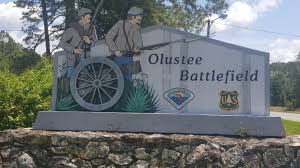
Greetings, this week we examine Florida's role in the Confederacy, its limited battlefield memory, and Olustee during Reconstruction. Florida's support of the Confederacy is often an overlooked aspect of the Civil War. As part of the original secessionist troupe, Florida joined Alabama, Georgia, Louisiana, Mississippi, South Carolina, and Texas as part of the first wave of secession from the Union. While the State legislature and a majority of the White Male population of Florida supported secession, some 2,000 people (both White and African) fled to join the Union. Aside from four regular contingents of men and two cavalries, Florida mostly supplied the Confederacy with salt, beef, and timber throughout the war. Salt was the best way to preserve the meat harvested from the vast cattle farms in the state. Enslaved Africans and other workers extracted this precious mineral from Florida's coastal waters with large metal boilers right on the beach. After evaporating all of the...

May the Living Profit by the Example of the Dead

Image
Greetings, this week the interns were tasked with reviewing the current literature surrounding the Lost Cause narrative and, more specifically, the Battle of Olustee. The Lost Cause, named after Edward A. Pollards book The Lost Cause: A New Southern History of the War of the Confederates (1866), twists the narrative of the Confederacy to include States' Rights as the focus of the Civil War, rather than the preservation of slavery. Additionally, the Lost Cause has come to include chivalric imagery regarding Confederate soldiers and generals, which distorts and whitewashes their memory. In modern times the Lost Cause appeared forcefully around the turn of the twentieth century. Founded in 1894, the United Daughters of the Confederacy (UDC) chartered themselves as a "Historical, Benevolent, Educational, Memorial and Patriotic" organization seeking to preserve the "shared" memory of the Civil War. While this is appealing in writing, the UDC has acted contrary to its...